
Getting Real
I'm in Italy. I need to act like it.

Cari amici,
I imagine many (most? all?) of you are like me these days, alternately or simultaneously horrified, outraged, and depressed by the daily news cycle. Not gonna lie, I’ve let it immobilize me, a lot. Now, though, I’m fighting back, and my method is simple: I’m spending less time obsessing about the state of the world, aka doomscrolling, and more time engaging in real-world life. Fortunately for me, this effort coincides with the start of rehearsals for season 2 of Teatro Immediato. Is there a better way to fight demons than by engaging in art? Nope.
So what provoked this sudden turnabout, away from the virtual and toward the real? It sounds silly, really—I walked down to the little Gesenu (trash/recycling company) truck that zips up my street each day at 4pm and zips away again at 4:15. I needed a new supply of recycling bags (provided free of charge to customers), and I got them—along with a sudden attitude shift.
A friend of mine, one of the actors in my little theatre group, Carlo, was there talking to the driver, a very chatty guy named Francesco whose adherence to his route schedule fizzles when he has a chance to chiacchiare. Carlo was telling Francesco about Teatro Immediato as I approached, which led to much enthusiasm on Francesco’s part and discussion all ’round in various directions. Finally I got around to asking for my bags, but alas, Francesco had only the blue and yellow ones for paper and plastic, not the white ones for organic material. No problem, I said, but Carlo wouldn’t hear of it and ran home to get a few white bags to tide me over, at the same time as another friend, Victor (also one of my actors), arrived and, upon hearing of the supply shortage, also raced off to get me a few of his. It was a nothing moment—just some people standing in the street on a sunny September day and talking about this and that, and, in the case of my two friends, offering kindness, and I just kind of yanked on the old mental brakes and thought, “This is it. This is my life here. You’re missing out when you’re at home prostrated by the daily barrage of evil. Pay attention.”
Shit is happening all over the world; that’s unfortunately nothing new. I can, and should, do what I can to combat what I consider to be the most egregious affronts to human dignity, people’s rights, and the law of the land. I can vote. I can boost the reach of worthy, ethical people. I can put my money where my mouth is. What I can’t do is forget to find pleasure in living. I moved to Italy to live here, not to cling to survival in some virtual hellhole.
Even before the Gesenu truck interlude I was succeeding in small ways, thanks to traveling. Getting out of my rut always pushes me to engage rather than disengage. I spent a week in Milan with one of my sons and we talked and ate and talked and saw art and walked and talked and played board games and talked and talked and talked. I went to Varese to meet some new-to-me cousins (also Ossolas, for whom I left a note in the Arcisate cemetery four years ago), and we talked over lunch and argued over the bill and shared genealogy data and photos, and it was great. And in a particularly big win for me, I left my introvert’s comfort zone and made two planned and two unexpected connections in Florence.
The first unexpected connection is a woman with whom I very uncharacteristically struck up a conversation at a restaurant (a shared favorite, as it turns out); we’re now Instagram friends, but hopefully will see each other again. The other is the woman who owns the B&B I stayed in. We got to chatting at length on several occasions, and she said to call next time I’m in town to meet up for coffee—even if I’m not staying at her place, she hastened to add. (Can you explain to me why I was super fluent talking to her but blow it daily with people in my neighborhood? I thought not.)
Of the two planned meetups, one is the friend of a friend, a warm, bubbly world traveler I look forward to hanging out with in Florence again. The other is a social media connection, art expert Alexandra Korey (here’s her website; on Instagram, she’s arttrav), whom I’d describe as a like-minded soul and who generously did an expert read on the novel I’ll be shopping around soon. Holy cow, four new friends (friends-ish?) in less than 48 hours! (Note to self: talking to people is good.)
Alexandra suggested we go see Plautilla Nelli’s restored Last Supper, which I reference in the aforementioned novel but hadn’t seen, and then schmooze over drinks at Todo Modo, a bookstore/café. She and I dashed into Santa Maria Novella, making the last entry by a hair’s breadth. (May I digress here to say that viewing art with someone who has a PhD in art history is totally the way to go? I doubt I’ve looked at clothing or food, including bread and butter and a curled-up little lamb, quite so analytically before. And so much of art appreciation can be found in the details; for example, I just read that the Baroque sculptor Bernini had a supposed “signature” of leaving a button partially undone. Where buttons exist, that is. None of my favorite sculptures of his (his David! his Apollo and Daphne!) have them.
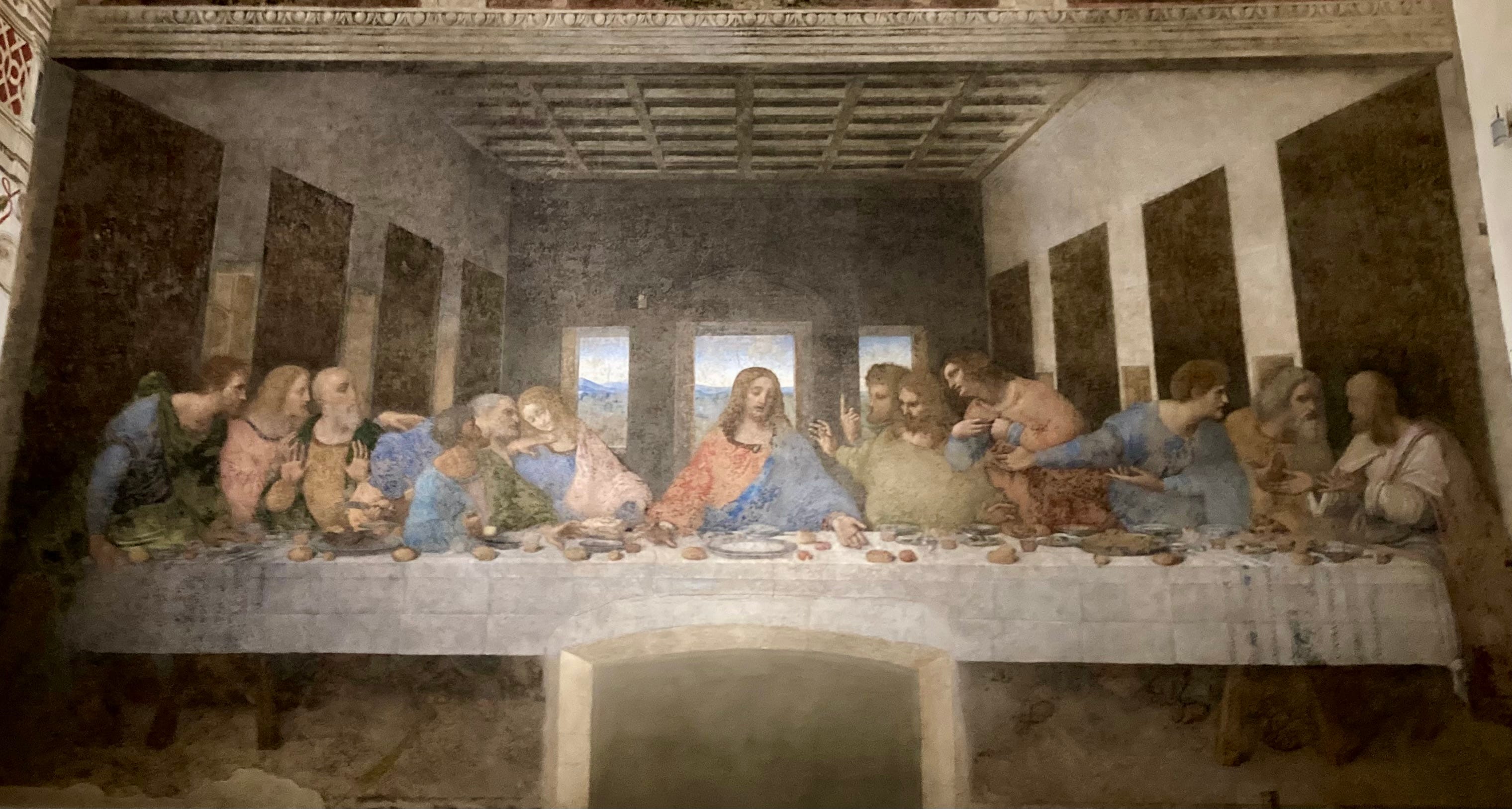
Plautilla is a hugely important presence in Renaissance art, being 1) female; in fact the first known woman painter in Florence, and 2) the painter of unusually large (for women) works, and 3) a Dominican nun. Her work was groundbreaking, her legacy that of an inspired teacher (she ran a bottega there at the convent). Her Last Supper was a shock for me, coming as it did on the heels of my fourth viewing of Leonardo’s in Milan. The Leonardo, a fresco painted in 1494–98, has deteriorated greatly (at least partially because of an experimental technique he devised because he didn’t like working in fresco), and though it’s been painstakingly restored it’s still worn, and the colors are quite soft.
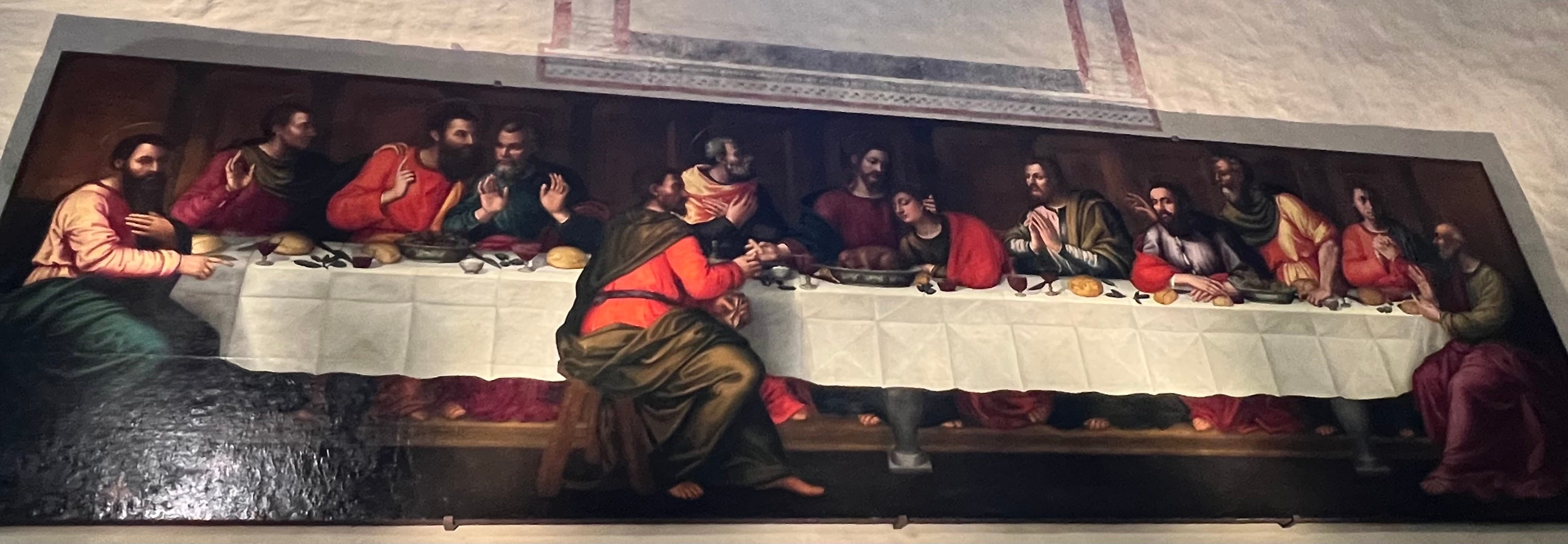
In contrast, Plautilla’s palette for her Last Supper, an oil painting of enormous scale, is vibrant, full of rich reds, glowing oranges, and bottomless greens and purples. Painted in 1568, only 70 years after Leonardo’s, Plautilla’s version falls into the late Renaissance period called Mannerism, though it would shortchange a work, and an artist, to slap on a label that prescribes certain methods or qualities. Any artist’s work is a blend of influences by predecessors and contemporaries, access to resources such as technical training and anatomy studies, awareness of current artistic innovations, inspiration, and (not least) talent. Setting aside any analysis of style, suffice it to say that, seen back to back with the Leonardo, the Plautilla Last Supper seems drastically more modern. (I wish I’d brought binoculars; the painting is mounted so high on a wall that seeing details is difficult.)
Another note to self (and to all of you art lovers): make more of an effort to view art this way—in paired studies like the two Last Suppers, or by finding historical links, like I did years ago when, after being stunned by the 3rd century AD Ercole (Hercules) Farnese at the Museo Archeologico Nazionale di Napoli, I hopped a train to Rome to visit the Baths of Caracalla, where the statue once stood. What a breathtaking experience that was, having that enormous statue, more than three meters tall, so vividly in mind and imagining it standing in those once-splendid baths, its scale made human by soaring walls.
Along with trying to break out of my shell more often, I need to stop my anxiety-fueled sleepwalking and be more aware of the beauty that surrounds me when I’m at home. As Sarah Bringhurst Familia wrote in a recent post, access to everyday beauty is a big part of why she lives in Europe. She writes:
“Not everyone seems to notice it, or care, but for those with an inborn thirst for beauty, it can quickly become a necessity. Like air. A reason you can’t imagine going back [to your home country].”
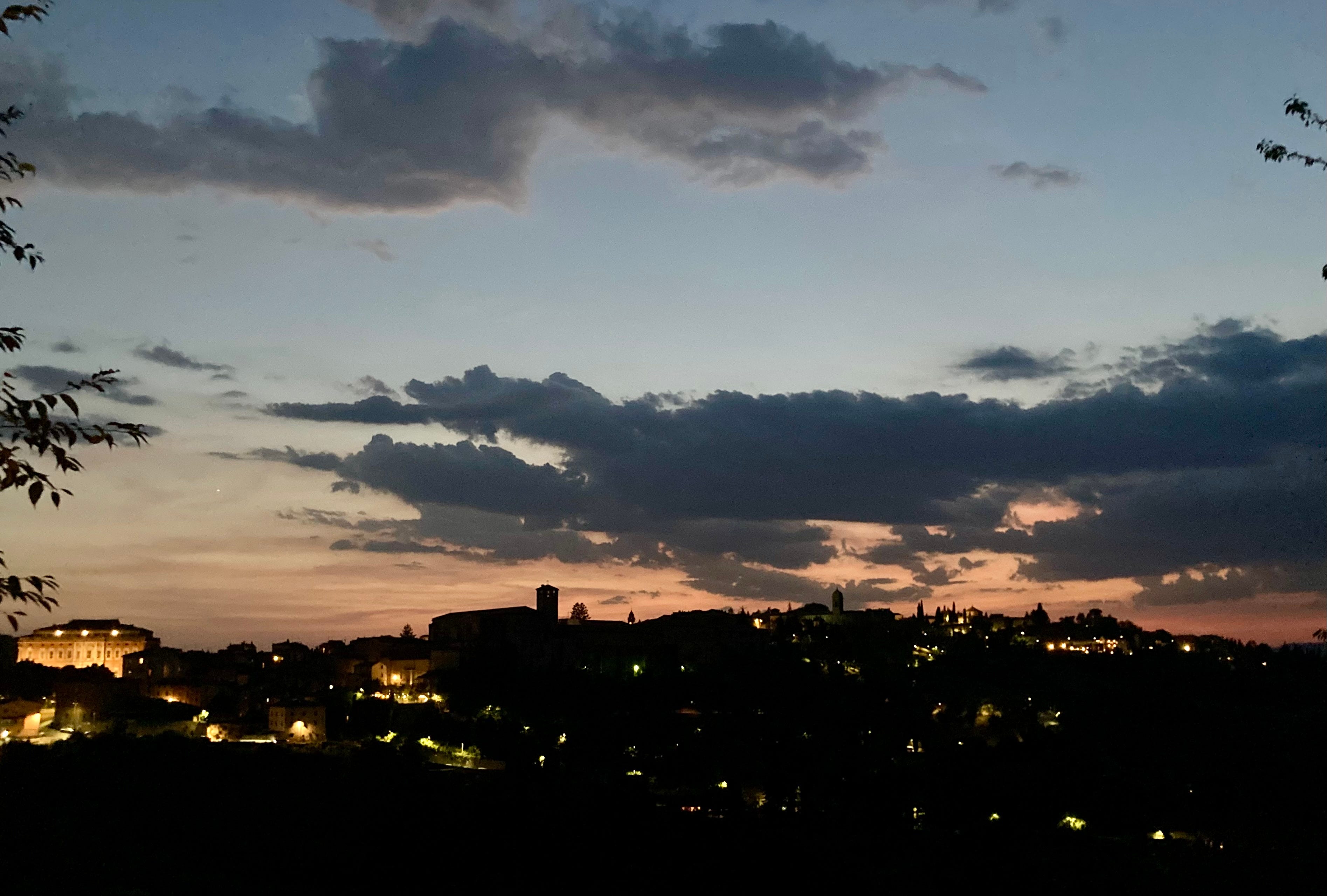
Yes, yes, yes! I think of this when I’m standing outside one of Perugia’s ancient city gates, watching the summer sun make its exit while my dog does her nightly ritual. The city lies sprawled on a ridgeline like a cat on a tree branch, its pale stone warmed by the day’s last light, its rooftops and spires sharp accents against the fading sky. It’s spectacular. It’s absolutely an everyday, garden-variety form of beauty, and part of what makes living in a place that’s millennia old so magical.
Circling back to the beginning of this piece, I heard something yesterday that prompted me to tweak my definitions of “real” and “not-real.” It was a clip of a recent Daily Show interview with the Nobel Laureate, journalist, and author Maria Ressa. Addressing that very issue, she said the quiet part out loud: “online violence is real-life violence.” She’s right. What we experience online—the gratification, the shaming, the rage, even the appreciation of wit or beauty—is as real as those sunsets I see, as real as any fresco or oil painting, as real as an impromptu streetside conversation. But we can choose which reality gets more of our precious time and how we respond to it.
I moved to Italy for many reasons, answering an urge that began when I was just a kid, a proud Italian American. I worked hard to get here, still work hard even after seven years to adapt to cultural, societal, and language differences and to take advantage of what living in Europe offers. There’s a lot I want to do yet—spend more time with friends, for example, and travel, and write more books, and paint my living room a shimmering jade green. I want to fill my visual reservoir with unforgettable art and architecture, fall speechless when faced with Italy’s natural beauty. For a while now, I’ve let the bastards get me down. I’ve let them steal from me some of the joys of living in Italy. Mea culpa. And basta.
Tante belle cose, alla prossima—
Cheryl
PS: Some good news! A poem of mine that was published online by Eastern Iowa Review was selected for publication in EIR’s 2025 anthology. If you’re interested in prose poetry (great stuff in here!) and/or supporting small presses, you can order it here.
PPS: Today is a general strike in Italy in solidarity with the people of Palestine. It’s heartwarming to see how far-reaching the effort is here: my doctor sent out a message saying she’d be out of the office today and encouraging people to show their support, and my favorite pizza restaurant has a sign in the window announcing its closure today in support of Palestine. Seeing these responses is a good reminder of what makes Italy a remarkable (and yes, often frustrating) place to live.
Italian words of the day
parecchio—a lot
apparecchio—device or appliance (most recently heard in reference to an orthodontic retainer)
a posto—all set
apposto—affixed, applied
forza—strength, force (or, as an exclamation, “let’s go!)
per forza—necessarily
What I’ve been reading:
Still Life by Sarah Winman
Yellowface by R.F. Kuang
Second Place by Rachel Cusk
Crime and Punishment by Fyodor Dostoevsky
One more P.S.—my book!
Which you can buy here or on the usual sites, or, better yet, order it from your local bookstore. Another fab option is to ask your library to stock it. If you read it and like it, please tell your friends and/or leave a few lines of praise on any bookish site. You’d be surprised how much a rating or review helps authors. Baci!
We've been feeling similarly-- we moved to Italy from New York a year ago, but somehow still find ourselves mired in the USA news cycle, which is not a place anyone would wish to be. It feels crazy to be wandering around Lake Como, or Rome, or Florence, or Milan obsessing about Jimmy Kimmel. Thanks for a reminder to focus on the beauty we're living in...
Love these small bites of Italian vocabulary. Grazie mille.