
On Introversion and Art
And how I gave up one to find the other at a flower show


Cari amici,
First, some exciting Italian citizenship news! Yesterday the highest court in Italy, the United Sections of the Corte Suprema di Cassazione, ruled that the original interpretation of an article of a 1912 law determining whether the foreign-born (in jus soli countries) minor children of Italian citizens who naturalized in another country was correct. Since late 2018, this article has been incorrectly applied, denying the right to citizenship to thousands of descendants of Italian citizens, including me. It’s fantastic news for me, but not for everyone. I won’t get into all the details; if you’d like to read more, go here.
Also, last week the Constitutional Court referred a case involving what’s known as the Tajani decree law (Legge 74/2025), which in effect strips hundreds of thousand, if not millions, of Italian descendants of their Italian citizenship, to the Court of Justice of the European Union. This is something of a turnaround for the Constitutional Court, which previously upheld Legge 74. It’ll be 12 to 24 months before we see any results from the EU court. Again, to read more, go here. Or, to learn about both, you can watch this video.
Now that I’ve upstaged myself, on to my original topic.
People often ask me if my writing has changed now that I speak two languages and live in a country far from the one I grew up in. The answer is yes. What they don’t ask quite as often, though, is whether I’ve changed—the way I think and perceive, how I present myself to the world, what I take away from my experiences, both quotidian and cumulative. The answer to that question is also yes. So let me illustrate one way I’ve benefited from hurling myself across an ocean and making a life in a country whose language and culture turned out to be far less familiar to me than I thought they would.
I’m an introvert, happy at home with my books, my writing, my obsessing about moving to another city or town, my lusting over real estate options and cats up for adoption. Oh, I can be social, hold down my end of a conversation, even volunteer to speak when I don’t have to, but that’s learned behavior. I often prefer solitude over socializing, and when I do put myself out there I need downtime to recover. But I’ve learned something after eight years in Italy — life gets very interesting when you talk to strangers.
One weekend in May was a “talking to strangers” double whammy. In the weekly language exchange group I frequent, I met two women who were here in Perugia for extended visits. I invited them to go to a friend’s book event at RosaFidelia, the annual rose show at Villa Fidelia in Spello, a small town about half an hour from Perugia. They were happy to come along.
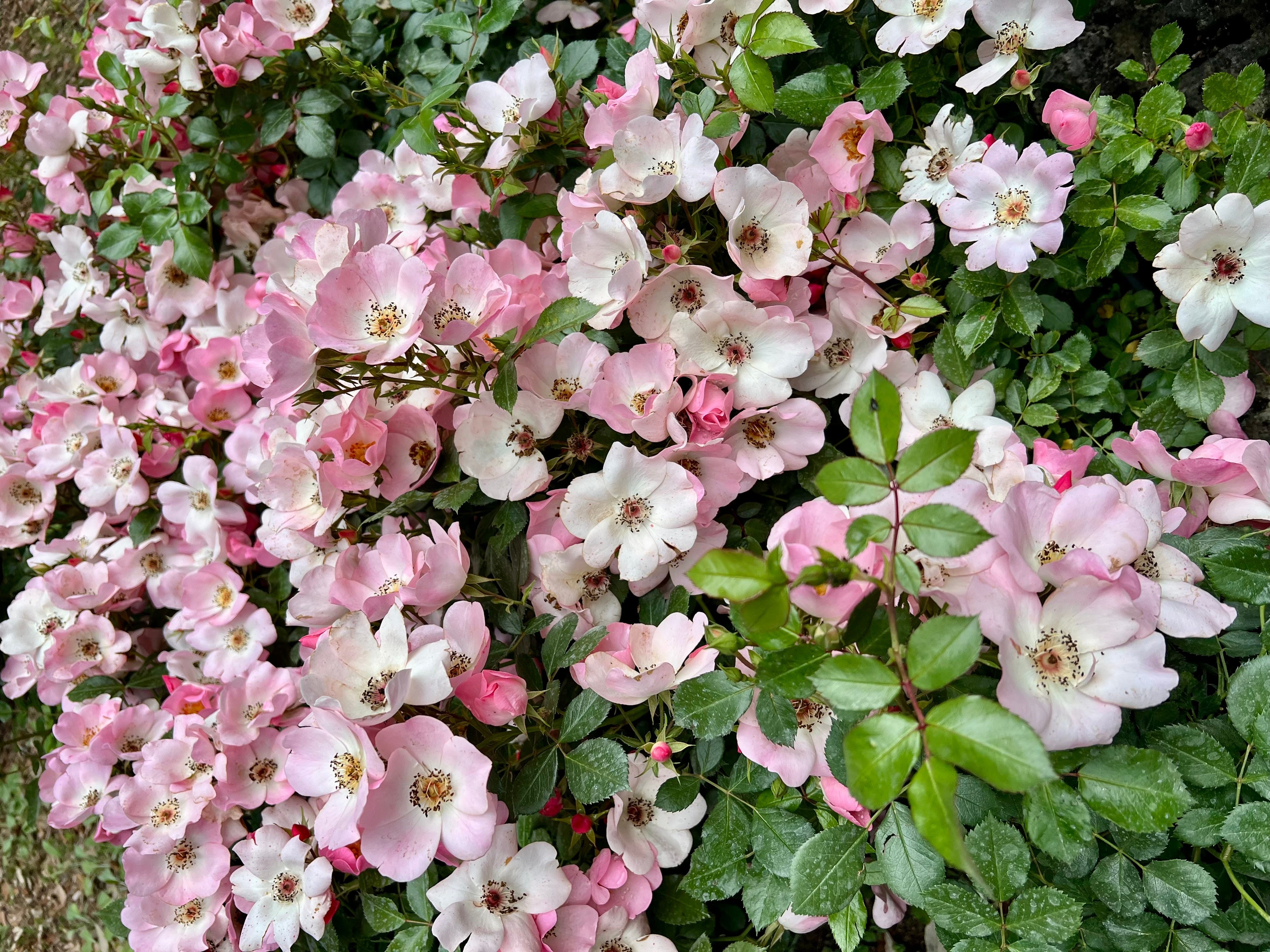
I’d never been to this annual event at Villa Fidelia, and somehow I’d convinced myself that the villa grounds included a permanent rose garden.1 Instead, the show is a marketplace of roses and other plants, plus garden- and plant-themed products. This year’s theme was La Scelta (The Choice); consequently the 140 vendors, as the website says, offered “meetings and activities related to sustainability, green care, and the valorization of natural and cultural heritage.” We saw roses of all kinds and colors, including my favorite antique variety, one of which I own but whose name I’ve forgotten.
Often, in Italy, I find that if I ask someone a single question, I’ll end up in a 30-minute conversation. And, shockingly, I like it! (Well, most of the time.) That’s what happened when my new friends and I stopped to chat with a mother-and-daughter team that makes clothing, scarves, and table linens with botanical designs. They make their products by painting (freehand and stenciled), by melding wool and linen, and by transferring plant colors and shapes onto fabric.
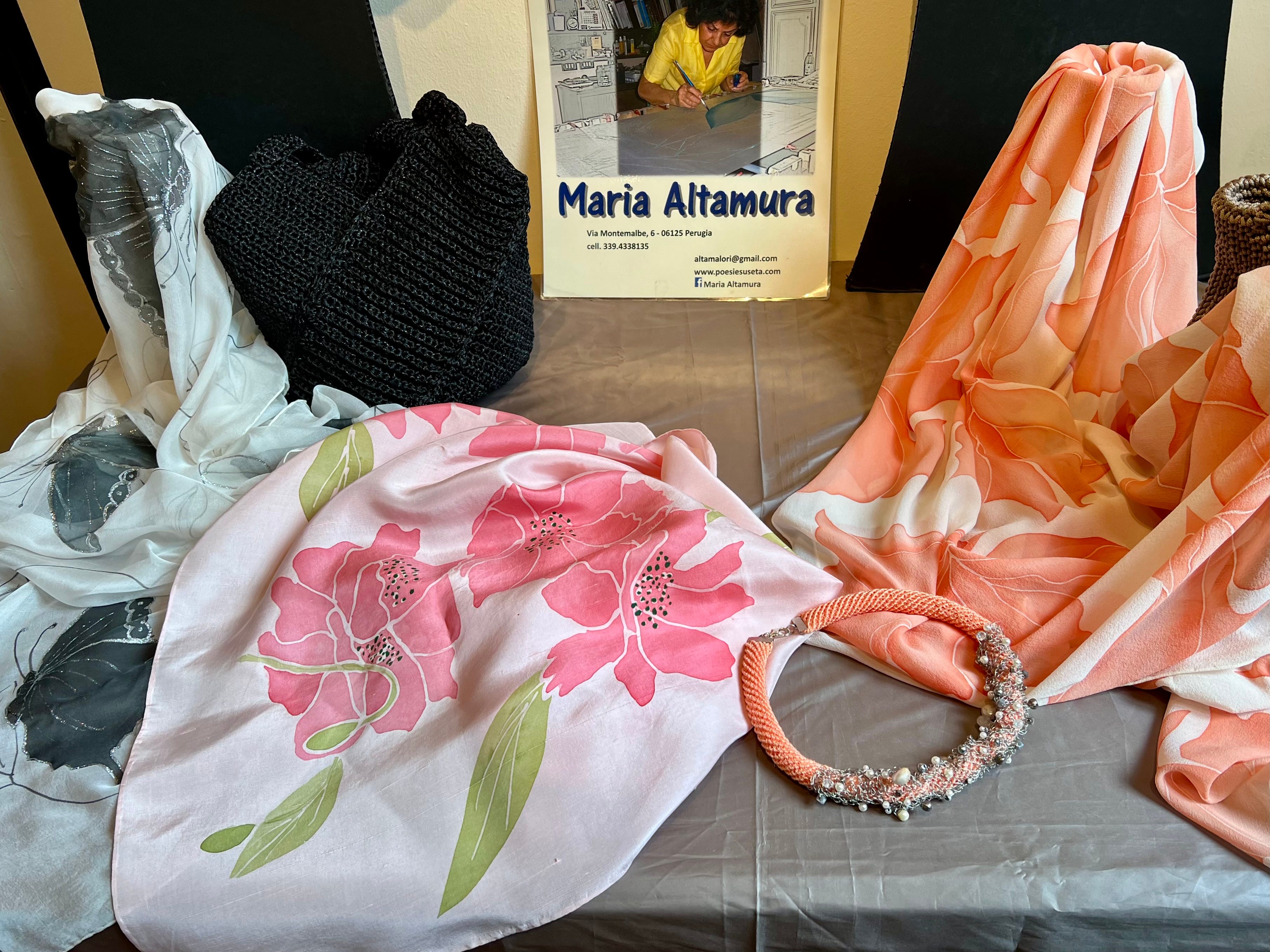
Maria Altamura and her daughter were very friendly, eager to explain the methods they use, some of which they came up with through trial and error. For example, certain flowers or leaves, when placed on fabric in sunlight for extended periods of time, produce a transfer effect better than others. Most if not all of their products are one-of-a-kind due to variations in color, pattern, or texture. During the transfer process leaves and flowers can yield unexpected colors and varying degrees of opacity or transparency, and rubbing wool into silk until the fibers mesh produces patterns that can’t necessarily be replicated.


Once we’d finally extracted ourselves from that conversation, we headed off to my friend Barbara Lachi’s book presentation, which was part of a panel discussion titled “Ritornare all’incanto: esempi di rinascita di giardini d’epoca” (“Return to Enchantment: examples of the rebirth of vintage gardens”). Barbara’s book, Un Jour, Un Jardin, which she wrote (in Italian; the book was translated into French) and illustrated, brings to life the garden at writer Italo Calvino’s childhood home; other participants described the restoration2 of the gardens of two historic villas.


If this sounds like an atypical mix of events for a garden show, it isn’t, at least not in Italy. Here, art and nature can often be inseparable; at the least they’re natural and frequent bedfellows. The day turned out to be lovely thanks to new friends and acquaintances—one more reminder that when I venture out of my hermit’s lair there are discoveries, surprises, and, always, moments of beauty. One of my new friends, Sara, a Canadian, said she never talks to strangers in her home country the way she does here, and we both wondered if our tendency to come out of our shells is a side effect of the sociocultural differences between Italy and North America.
Maybe so. One thing that lures me out here in Italy is the knowledge that I might go somewhere with certain expectations in mind but probably won’t find them. What I find, often, is something better, an experience that comes from the people I meet and the way they toss their art, in whatever form it takes, across my path.
Tante belle cose, alla prossima—
Cheryl
L’italiano from literature
Nouns and adjectives derived from characters in literature, courtesy of @learnamo and @accademiaitalica on Instagram.
rocambolesco: describes a situation filled with unforeseen circumstances, where things go wrong, one after another. The word comes from the character name Rocambole, the protagonist of novels by French author Pierre Alexis Ponson du Terrail.
un anfitrione: a very hospitable person. From Anfitrione, a character in Greek mythology made famous in Roman playwright Plautus’ play by the same name (Old Latin period).
dantesco: a chaotic, confusing, and often overcrowded situation. From (you guessed it) Dante’s Inferno.
un sosia: a person who’s identical to another. From the character Sosia, Anfitrione’s servant in Plautus’ play Anfitrione(Anfitryon).
amletico: an adjective used to describe agonizing doubt or indecision. From (you guessed it again) Shakespeare’s Hamlet.
un dongiovanni: a charming, seductive man who’s always looking for new romantic conquests. From the character Don Giovanni Tenorio, who in literature and opera is a donnaiolo (a womanizer).
Book of the day
The Odyssey, translated by Emily Wilson
Poems of the day
All inspired by The Odyssey
“Siren Song” by Margaret Atwood
“Ars Poetica” by Jorge Luis Borges
“Penelope’s Song” by Louise Gluck
“Penelope” by Dorothy Parker
“The World as Meditation” by Wallace Stevens
P.S. My books!
How Long a Shadow can be preordered at Cynren Press, bookshop.org, Barnes & Noble, and Amazon (U.S.). It’s not yet available for purchase outside of the U.S. The Wild Impossibility is available on Amazon while supplies last; a new edition is forthcoming on August 18, also from Cynren. Three more ways to support authors: ask your library to stock their books, recommend the books to your friends, and leave a few lines of praise on any bookish site. You’d be surprised how much a rating or review helps authors. Baci!
A language aside: Though I know the word giardino can mean anything from a scrap of backyard to a city park, I still impose my American interpretation on it and expect flowers.
This is what speaking two languages can do to your brain: I first wrote “restauration,” blending the English “restoration” with the Italian “restauro.”
Lovely post, Cheryl! I think it will be of great interest, for several reasons, to my greatly treasured friend Grace Cavalieri. I will share it with her. A presto!
Cheryl, grazie mille for your lead off announcement about the minor issue. It truly has been earth shattering change and has given hope again to so many